

MSGC Internships
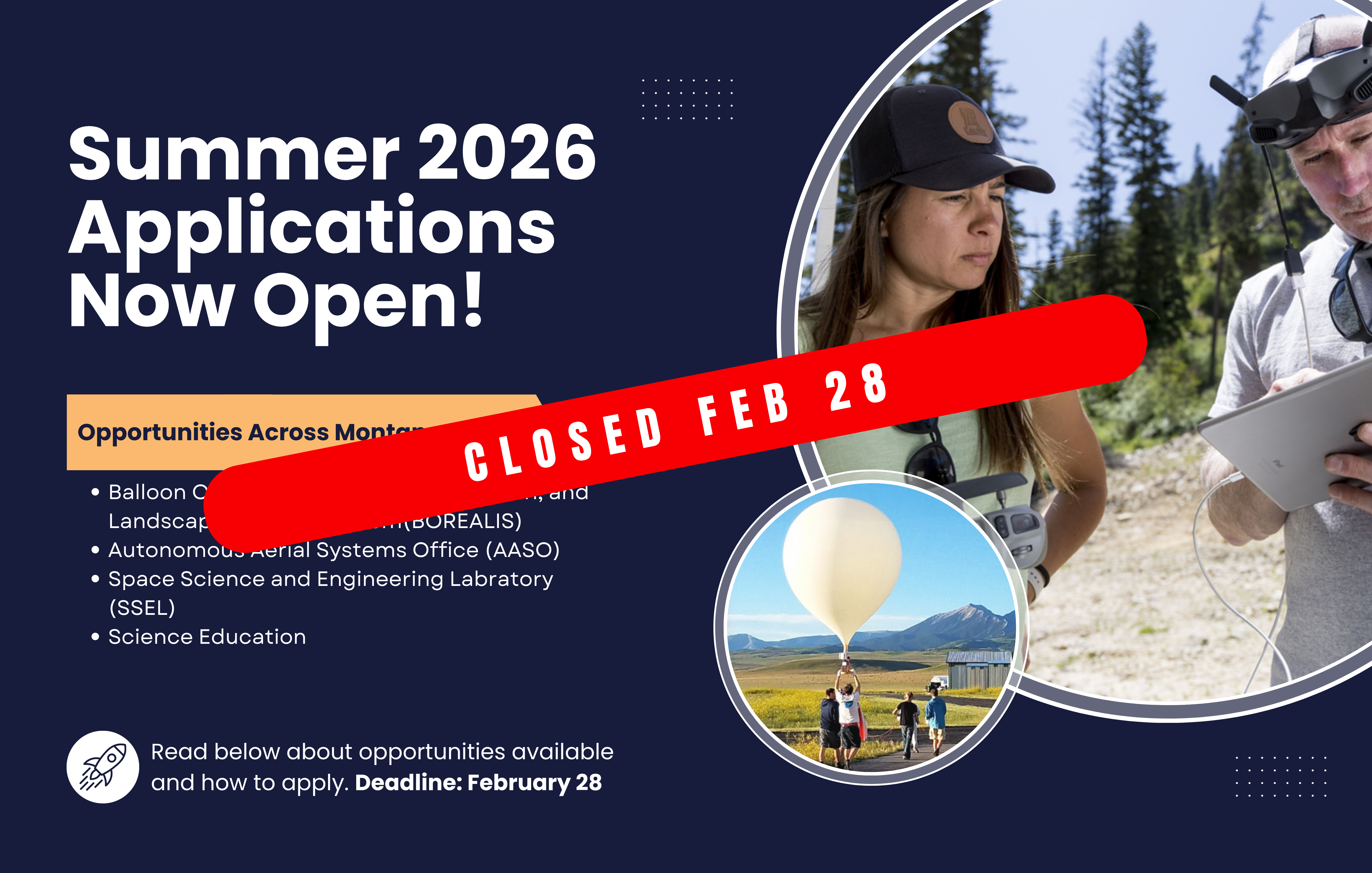
Montana Space Grant Consortium (MSGC) works with mentors at our affiliated institutions around the state to bring Montana undergraduates hands-on opportunities under the Big Sky. MSGC's goal with internships is to help bolster students' work experience in NASA-related fields. If you have any questions, please feel free to reach out to our office.
Internship Details
- Interns work with their mentors for 10 weeks at 40 hours per week unless otherwise stated
- Two types of interns: Standard and Peer-Leader. Students who have had previous research experience can apply to be a Peer-Leader (see below under More Information)
- Pay is $7,000 for a Standard Intern and $7,500 for a Peer-Leader
2026 Internships are closed - Sign up to our newsletter to receive future student opportunities.
Qualifications for MSGC Internships
- Must be a U.S.Citizen.
- Must be an undergraduate student enrolled at one of the Montana Space Grant Consortium affiliated campuses at least a part-time (6 credits or more).
- Graduating seniors do not qualify unless they have been accepted to a graduate school in a STEM discipline in the state of Montana.
Required Deliverables for MSGC Internships
- Complete an award acknowledgment and accompanying paperwork prior to starting the internship.
- Complete the Responsible Conduct of Research (RCR) training course prior to starting the internship.
- Complete a final report of at least 2-pages of content at the end of the term.
- Complete a final presentation by the end of the term.
- The presentation can be an oral presentation or a poster presentation
- Prior to presenting, submit this form to allow MSGC staff the opportunity to attend your presentation
- Oral Presentation Expectations
- Poster Presentation Expectations
- Complete a confidential end-of-term evaluation.
2026 MSGC Summer Internships Opportunities
Paid summer internships are available for students from Montana campuses with the Balloon Outreach, Research, Exploration And Landscape Imaging System (BOREALIS) program at Montana State University - Bozeman.
Students work in an interdisciplinary, mission-like team environment where they are encouraged and mentored to design, develop and deploy experiments to the edge of space (100,000 feet). Students receive training and hands-on experience in using upper level wind forecasts for flight track predictions, balloon inflation and launch and the use of tracking systems for recovery of the experimental payloads. Additional opportunities include training in computer programming and modeling of wind forecasts and simulations. Students from all majors are welcome.
These positions (approximately six) are located in Bozeman.
Paid five-week summer internships are available for students from Salish Kootenai College, Blackfeet Community College, Flathead Valley Community College, and the University of Montana with the Balloon Outreach, Research, Exploration And Landscape Imaging System (BOREALIS) program at a college in North-Western Montana. The program runs July 6 - August 7.
Students work in a mission-like team environment where they will learn to fly weather balloons to examine atmospheric dynamics up to 115,000 feet in altitude. The program focuses on meteorology, climate science and aviation with weather balloon launches and data analysis. Students receive training and hands-on experience in using upper level wind forecasts for flight track predictions, balloon inflation, designing field campaigns, and basic atmospheric dynamics.
These positions (approximately four) are located in North-Western Montana.
AASO is considering summer positions for motivated interns interested in working on several possible projects. These positions are located in Missoula, MT on the University of Montana Campus. Projects include building UAS and custom UAS sensors, and UAS for river and vegetation monitoring.
The Autonomous Aerial Systems Office (AASO) mission is:
- to coordinate and guide faculty, staff, and students in Montana for understanding and decision-making regarding the implementation of UAS in a changing research and regulatory environment.
- to establish the infrastructure and resources in order to create sustainable autonomous aerial research.
- to stimulate UAS-related innovation, entrepreneurship, and workforce development in the state of Montana.
In addition to standard internships, AASO also offers peer-leader internship positions. Peer-leader interns have all the responsibilities and opportunities of a standard internship, plus additional duties related to peer mentoring, project management, and research support. Peer-leader positions offer a higher pay rate to compensate for additional responsibilities.
The intern would need to have some experience with or a strong aptitude to learn:
- C++, R, or Python Coding
- Flight Controller Programming
- Infrared Image Processing
- Digital and/or Analog Circuit Design
- GIS experience
- Multispectral image analysis.
These positions (approximately six) are located in Missoula.
Up to three students, sophomores through seniors, from MSGC Affiliate campuses will have the opportunity to participate in the development of space science/engineering experiments at the Space Science Engineering Laboratory at the MSU – Bozeman campus. Students will receive complete training and mentoring from MSU students and SSEL staff experienced in space hardware design. SSEL programs to design, fabricate, test, and fly systems in the space and near-space environment include rockets, balloons, and satellites. Visit the SSEL website for more project information.
This opportunity is designed to enable college students to participate in a missionlike team environment where students design, build, and fly space hardware. Approximately 20 people will work in the SSEL over the summer on various group or individual projects, making the environment rich and supportive. SSEL also offers peer-leader internship positions.
These positions (approximately three) are located in Bozeman.
The Montana American Indians in Math and Science (MT AIMS) program provides hands-on STEM-related summer experiences for students from Montana’s tribal communities. There are three components to MT AIMS:
- Gatherings – a 10 day in-person experience for middle school students.
- Pathways – a 5 day in-person experience for returning middle school students.
- Journeys – a 12 day in-person experience for returning 9-10th grade students
The summer intern will help in developing and implementing NASA and/or STEM-related daily activities for the Gathering participants and longer 5 – 10 day focused projects for the Pathways and Journeys participants. These residential programs run in June and July on the University of Montana campus. The intern will work and be compensated for 300 hours, working mid-May through the mid-July.
This position is located in Missoula.
Global change has increased forest mortality, changed tree species distributions, and altered terrestrial C dynamics in unpredictable ways. Our research seeks to link plant function with hyperspectral imaging to improve our ability to monitor and predict conifer tree survival and mortality under stress (e.g., drought, heat). In a largescale greenhouse experiment on four tree species, we will examine how tree carbohydrates influence drought and heat stress resistance and survival. We are currently seeking highly motivated and enthusiastic interns to join our team for a summer internship working in the lab and greenhouse. As a summer intern, you will work closely with a PhD student mentor. Join us in making a positive impact on the environment through groundbreaking research!
Intern Responsibilities
- Greenhouse: Collect leaf spectra and physiological data from various tree species in a controlled greenhouse environment.
- Lab: Process and prepare samples for analysis of non-structural carbohydrate content, including grinding and weighing tree tissues.
- Data Analysis: Process and analyze the collected leaf spectra and physiological data to identify patterns and correlations related to tree health and mortality.
Qualifications:
- Strong interest in plant physiological ecology research.
- Excellent communication and teamwork skills.
- Ability to work independently and take initiative.
- Strong organizational skills and attention to detail.
These positions (approximately two) are located in Bozeman.
Our lab studies how plant populations and communities respond to environmental variability, including more frequent wildfires, earlier snowmelt, and warmer temperatures. We combine population monitoring, vegetation surveys, plant trait measurements, pollinator studies, and greenhouse experiments to predict how plant populations will persist under climate variability. We are currently seeking highly motivated and curious undergraduates to join our team for a summer internship working in the field, lab, and greenhouse. As a summer intern in our lab, you will work closely with a mentor to contribute to ongoing research projects:
- Monitoring populations of alpine plants in preserves around Missoula, MT;
- Studying floral color variation in response to climate and pollinator choice;
- Surveying park-goers’ support for plant conservation actions;
- Quantifying plant and insect diversity in thinned forest stands;
- Monitoring understory vegetation recovery post-wildfire.
Intern Responsibilities
- Monitoring plant populations in the field;
- Conducting vegetation and insect surveys (no identification experience required);
- Collecting data on environmental conditions, soils, and tree regeneration;
- Preparing soil and plant tissue samples in the lab;
- Processing and analyzing collected data.
This position requires fieldwork in Missoula, near Condon, and in the Sapphire Mountains. A field team might camp for up to 4 nights at a time throughout the summer. Fieldwork includes hiking over rugged terrain and carrying personal and research gear.
Qualifications
- Strong interest in plant ecology and field research
- Willingness to learn new skills
- Ability to work independently and as part of a team
- Excellent communication skills
- Experience working outdoors and camping/backpacking
These positions (approximately 2-3) are located in Missoula.
Explore how environmental changes impact forest ecosystem function through a biogeochemical lens! Our group examines how changing climate conditions, altered fire regimes, and shifting plant community dynamics influence carbon and nutrient cycling in forest ecosystems. Our research focuses on impacts to forest function and resilience, including productivity, post-fire vegetation regeneration, nutrient cycling and carbon storage.
We seek a motivated intern to join our team investigating how short-interval wildfires influence soil carbon dynamics in subalpine lodgepole pine forests. Soils store the largest pool of carbon in conifer forest ecosystems, playing a critical role in ecosystem functioning and climate regulation. However, shifting wildfire regimes and broader global change may alter the stability of soil carbon, particularly in vulnerable soil layers directly affected by repeated burning at shortened intervals.
The intern will work closely with researchers, graduate students, and other undergraduates to assess how wildfire reburns shape the persistence and vulnerability of soil carbon stocks – and other related ecological topics associated with the broader project. A key focus is comparing two major pools: particulate organic matter carbon (POM-C) and mineral-associated organic matter carbon (MAOM-C).
POM-C consists of relatively fresh, plant-derived material highly sensitive to wildfire through direct combustion and reduced carbon inputs following reburns that limit vegetation regrowth. MAOM-C, often considered more stable due to mineral associations, may still be vulnerable in steep montane systems via post-fire erosion, sediment transport, and altered hydrology. This comparison may help reveal insights to immediate mechanisms for carbon loss and the impact for longer-term persistence.
The intern will collect, process, and analyze soil samples from a chronosequence of sites with historic and shortened wildfire reburn intervals. This 10-week internship balances field and lab work, with collaboration opportunities at the University of Montana’s Plant Ecology & Global Change Lab and the U.S. Forest Service Missoula Fire Sciences Laboratory.
Intern Responsibilities
- Fieldwork: Assist with vegetation surveys and soil sampling in fire-affected forest sites (plant identification skills are a bonus but not required!).
- Laboratory: Prepare and process soils for chemical analyses.
- Data management and analysis: Help process, store, and analyze data collected
- Collaboration: Work closely with researchers in the UM Plant Population & Community Ecology Lab and USFS Missoula Fire Science Lab.
Fieldwork Details
The bulk of the fieldwork will occur over ~2–4 weeks in remote areas of the Sapphire
Mountains. However, additional work with project collaborators may take the intern
to sites in Lolo and Helena National Forests in Montana. Tasks involve hiking over
rugged and steep terrain, carrying heavy gear, and camping in remote sites for up
to four nights at a time. This position is based in Missoula, MT, with fieldwork at
various locations across western and central Montana.
What We’re Looking For
- Interest in forest ecology, fire science, biogeochemistry or soils. With preference to applicants who have taken a soils course.
- Comfort working in remote and challenging outdoor conditions, including hiking and camping (please speak to you experience with this in your personal statement)
- Strong organizational and communication skills.
- Ability to pay attention to detail and to work both independently and collaboratively.
This position is located in Missoula.
The Montana Learning Center (MLC) is seeking motivated undergraduate students with a strong interest in astronomy and STEM education to support our observing and outreach programs. This astronomy-focused internship offers hands-on experience assisting with both nighttime and daytime telescope observing, helping to optimize and maintain observatory equipment, and supporting engaging astronomy experiences for students and the public. In addition to technical astronomy work, interns play a vital role in public outreach and education. Responsibilities include supporting astronomy-themed camps (such as Explore the Universe), assisting with curriculum delivery and hands-on activities, and helping lead small-group observing sessions. Interns also support Learning Center events, including the Beyond the Big Sky speaker and stargazing series, weekly camper star parties, and community outreach events.
This internship provides meaningful, real-world experience at the intersection of science, education, and public engagement—ideal for students considering careers in astronomy, science education, or science communication.
Key Responsibilities
• Assist with nightly and daytime telescope observing
• Support maintenance and optimization of observing equipment
• Help deliver hands-on astronomy activities for students and the public
• Assist with astronomy camps and small-group observing sessions
• Support public events, speaker series, and community outreach
Interested candidates should be eager to work with learners of all ages, self-motivated, comfortable in a public-facing role, and enthusiastic about supporting immersive, hands-on astronomy education.
About the Montana Learning Center
Located at Canyon Ferry Lake, the Montana Learning Center offers youth STEM summer
camps, teacher professional development, and the region’s premier astronomy program,
featuring Montana’s largest public-access telescope. In partnership with Montana State
University, MLC also facilitates NASA’s Northwest Earth & Space Science Pathways program
to enhance aerospace education across Montana.
This position is located at Canyon Ferry Lake outside Helena.
Our research addresses basic and applied problems in microscale manufacturing technologies and systems. Specifically, we use various microfabrication technologies, including photolithography and high-resolution 3D printing, to fabricate innovative devices for biological and electronic applications, such as sensors, actuators, electronics, and soft robotics. The intern will focus on investigating the fabrication and control technologies of magnetic microsphere swarms.
Intern Responsibilities
-
Fabricate microspheres using microfluidic devices.
-
Develop a three-axis Helmholtz coil system.
-
Navigate and control magnetic microsphere swarms
Preferred Qualifications
- Juniors or seniors
- Self-motivated and has a strong aptitude to learn
-
Has hands-on lab work experience, especially in a chemistry, materials science, or electrical engineering lab
-
Has circuit and Labview programming experience
Students would be working with a research group that is interested in understanding
the linkages between bedrock, soil, and vegetation chemistry and their spectra to
identifying geologic units and improve remote geologic mapping. Students would be
working with this team on mapping efforts in calderas along the Yellowstone hot spot
track. Students will help with improving the current geologic prediction model, requiring
chemical data collection and model training, collecting spectra on plants, soils and
rocks, and creating spectral databases. Opportunities to work with a VSWIR field spectrometer,
LIBS, LA-ICP-MS and UAV imaging spectroscopy system.
These positions (approximately two) are located in Bozeman.
Using atmospheric modeling and aircraft measurements to determine global sources of pollutants
This project will use a global model of the atmosphere (www.geos-chem.org) to simulate concentrations of key toxic air pollutants such as benzene and toluene. We will use airborne and ground-based measurements to test and improve the model. We aim to draw conclusions regarding the emission sources of these pollutants, in particular, from wildfires, and how they affect human health regionally. Students will use high-performance computing and should wish to gain experience with Unix and scientific programming. Prior programming experience is preferred but is not required; students can learn on the job.
Using a mass spectrometer to determine emissions of atmospheric organics from wildfires
This project will use a state of science equipment (proton transfer reaction mass spectrometer) to measure concentrations of organic pollutants from western U.S. wildfire smoke and urban pollutants. We will deploy a PTR-MS on a research aircraft to fly in Salt Lake City to sample organic compounds. Students will learn to operate a PTR-MS, trace gas calibrations, datalogger, automatic control system, etc. Students should wish to gain experience with scientific programming (R) for data processing and data analysis.
These positions (approximately two) are located in Missoula.
This project will develop robust vision-based control systems, initially targeting autonomous robotic submarine platforms. The work will focus on the critical link between sensor degradation—from biofouling, water conditions, or mechanical damage—and control failure. We plan to characterize the failure modes of standard vision algorithms under progressive image quality loss. Our core objective is to then systematically design a degradation-resistant perception system through novel data augmentation and model training. We hypothesize that this will lead to strongly damped, graceful degradation in control performance as visual inputs deteriorate, ensuring submarine operational resilience. Students will engage in generating synthetic and real degraded datasets, training and validating robust deep learning models in simulation environments, and testing algorithms on physical submarine platforms in controlled aquatic facilities.
These 1-2 positions are located in Bozeman.
Students interested in additional internships beyond the scope above, please reach out to our office separately to discuss the proposed potential industry and faculty members as partners. The proposed party must have agreed to work with the student prior to applying for the internship.
Internships must meet the 400-hour minimum requirement. Compensation is provided by MSGC upon acceptance. Student must complete MSGC required deliverables.
These positions may be located in or out of the state of Montana.
Application
2026 Internships are closed - Sign up to our newsletter to receive future student opportunities.
To apply, please include:
- Your preferred internship opportunities selected from the list above
- Two Letters of Recommendation
- Personal Statement
- Resume
- Unofficial College Transcript
Other Information
- Application Deadline: February 28th, 2026. Letters of recommendation are also due February 28th.
- Notification: Students will be notified at the end of March/beginning of April.
- One Application: One application can be used for multiple internships students are interested in. You can also save your work and come back.
- Peer-Leader Internships: These roles have all the responsibilities and opportunities of a standard internship, plus additional duties related to peer mentoring, project management, and research support. A higher pay rate is offered to compensate for additional responsibilities. Peer-Leaders are appointed on a case-by-case basis, dependent upon the internship mentor expectations and applicant skills and capabilities. Research mentors can request this designation for any students meeting these higher expectations in their program. Students interested in a peer-leader role can express their interest in their application.
- Child Care Financial Assistance: Child care support is available. Students interested in this assistance should describe their need in their personal statement. This support is possible through generous donations to the Hiscock Memorial Fund at the National Space Grant Foundation.
- Cost-of-Living Supplement: For those conducting internships in locations separate from where they live or attend school, we can offer a cost-of-living supplement. Inquire with the MSGC Staff at msgc@montana.edu.

Professional Resources
A personal statement is required for all summer internships. In your personal statement, include what you hope to get out of a MSGC summer internship. If you're applying to be a peer-leader, describe your planned leadership actions.
Typically, a personal statement outline looks like this:
- Opening paragraph (open with a story that relates to your chosen career path)
- A few paragraphs on your skills and knowledge that relate to the application—and how that benefits the mentor and research
- Your life goals and how you see this internship getting you there
- Closing statement which refers back to your story and wraps it all up
MSGC has done sessions on STEM Resumes in their STEM Student Professional Skill Symposia. Content can be found on the Student Resources page. You can review the slides or the video. Let us know if you have any questions. msgc@montana.edu
Ask for LOR early in your application process. This gives the recommender time to plan and think about your letter intentionally.
The most impactful letter usually come from a professor. You can ask in person, but you should follow up with an email. Here is a template that you can modify:
Subject: Recommendation for ___ (First and Last Name) ___
Dear Professor ____________,
My name is _________________ and I was in your [BLANK] course during fall 20__.
I am applying to internships with Montana Space Grant Consortium and I am writing to ask if you would be willing to write a letter of recommendation for me. I am requesting a letter from you because you helped to inspire me to further pursue the field of [YOUR FIELD] and you were extremely helpful when I had questions about the course as well as with ideas for research. Your course made me think more deeply about research and I appreciated your direct and unique approach to instruction.
My application, with letters of recommendations are due February 28th, 2025 and I would greatly appreciate a letter for me. I am attaching my resume for you to review. If you agree, I will submit your information in the online recommendation form. Let me know if you have any questions or concerns.
Thank you for your time.
Full Name
Student ID# ______________
[UNIVERSITY] E-mail:_______________
Phone: ___________________